
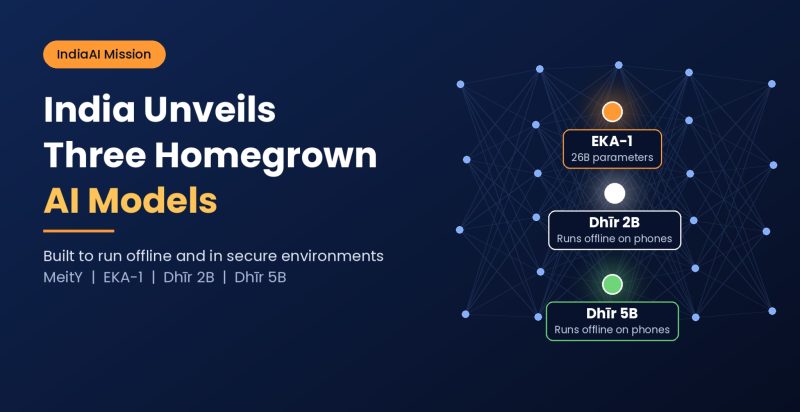
For years, the AI race was about size, with bigger models promising better results. India is now backing a different idea: small, specialised models built for specific jobs, languages and devices.
What Are Small And Specialised AI Models?
Small language models (SLMs) have far fewer parameters than giant chatbots. They are trained for focused tasks such as healthcare queries, speech recognition or a single industry. That makes them cheaper to run and easier to deploy.
India’s Government Bets On SLMs
Under the IndiaAI Mission, the government has identified 20 indigenous AI model proposals, 12 large language models and 8 small language models. Union Minister Ashwini Vaishnaw told Parliament in July that domain-specific SLMs for healthcare, language technologies and agentic AI are at various stages of development and deployment. The Mission itself has an outlay of Rs 10,371.92 crore.
Efficiency Is Built Into The Design
India’s strategy talks about a “frugal, sovereign and scalable” AI ecosystem. Sarvam AI’s 105-billion-parameter model uses a mixture-of-experts design with roughly 10.3 billion active parameters. BharatGen’s Param2 is a 17-billion-parameter mixture-of-experts model covering 22 Indian languages. Both show that smart architecture can matter more than raw size.
AI That Runs Offline
Sarvam also showed Sarvam-Edge, a model that runs entirely on consumer devices without internet. For a country with uneven connectivity, that could bring AI to villages and small businesses.
Why Smaller Could Be Better For India
- Lower cost: Startups and small firms can afford to run them.
- Local languages: Models can be tuned for Indian languages and dialects.
- Data privacy: On-device AI keeps sensitive health and financial data local.
- Focused accuracy: A model built for one task can beat a general one on that task.
The Challenges Ahead
Experts note that India still has no frontier-scale model, and Sarvam’s 105B is competitive with mid-tier global models mainly on Indian-language tasks. Quality data in low-resource languages and sustained compute remain hurdles.
The Road Ahead
If India’s builders can pair affordability with accuracy, smaller AI systems could power healthcare, farming, education and governance at scale. The next breakthrough may not be bigger, but better targeted.