

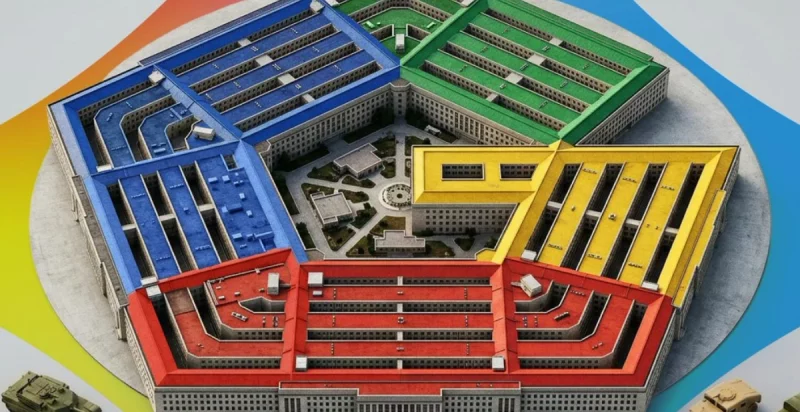
Google Pentagon: The Agreement is likely not an announcement most people will be excited about when it comes to sharing on social media; however, it will have an impact on the future of artificial intelligence (AI). The USA Government had been working with Google in developing its AI models for some time, providing AI capabilities to classify government data and processes.
This ends the discussion about AI being just an “experiment;” AI now becomes part of the security framework of the nations and will eventually be used by many governments worldwide.
What This Means in Practical Terms
The agreement allows the Pentagon to deploy Google’s AI in secure environments for lawful purposes. That could range from analyzing intelligence data to supporting operational decisions.
It builds on a larger $200 million contract signed earlier, but what stands out now is the level of access. The barriers between commercial AI and military systems are getting thinner.
Big Tech Is No Longer on the Sidelines
Google isn’t alone here. Companies like OpenAI and xAI are also stepping into defense partnerships. Even Meta has explored AI-led military applications.
This reflects a broader shift—AI is no longer just a business tool; it’s becoming part of how nations think about power and security.
Not Everyone Is Comfortable
That said, the industry isn’t fully aligned. Anthropic, for instance, has reportedly held back from similar deals, raising concerns about how AI might be used—especially in surveillance or autonomous weapons.
So while some companies are leaning in, others are drawing lines.
The Bigger Picture
Google Pentagon: What we’re seeing is a transition. AI is moving from innovation to infrastructure, especially in high-stakes sectors like defence.
And once technology reaches that stage, it becomes harder to separate from the systems it supports. The question now isn’t whether AI will be used in military contexts—it already is.
The real question is how far it will go, and who gets to decide its limits.