

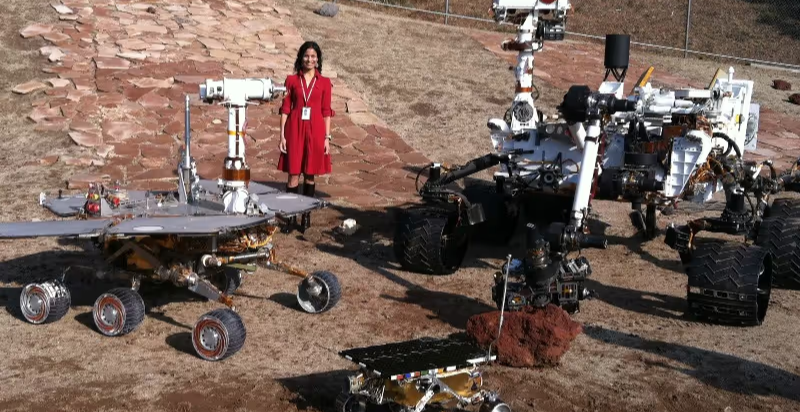
The Indian scientist Vandi Verma from NASA’s Jet Propulsion Laboratory has achieved a historic milestone by conducting the first rover drive on Mars which was planned through artificial intelligence.
Who Is Vandi Verma?
Vandi Verma is a robotics engineer at NASA JPL and plays a vital role in developing Mars rover missions, including Perseverance and Curiosity. She focuses on autonomous systems development.
What Is the AI-Planned Rover Drive?
Traditionally, humans on Earth created complete movement plans for rovers to follow on Mars. The new AI-planned drive enables the rover to study the terrain, assess risks, and select its own path without requiring continuous human guidance.
Why This Breakthrough Matters?
Mars communication delays make real-time control impossible. Rovers can cover greater distances while efficiently avoiding dangerous areas by planning routes with artificial intelligence, enabling them to complete their missions more quickly and effectively.
Beyond Human-Planned Routes
This AI-driven system enables rovers to explore areas that humans would typically avoid because of their uncertain and dangerous conditions. It enables scientists to discover new geological features, hidden landscapes, and untouched Martian terrain.
Impact on Future Space Missions
Vandi Verma’s research establishes the groundwork for upcoming robotic and human exploration missions to Mars and other destinations. Autonomous navigation will become essential for missions that last longer than usual, for lunar exploration, and for asteroid research.
A Proud Moment for Indian-Origin Scientists
Her achievement highlights the global contribution of Indian-origin scientists in cutting-edge space research. It also inspires young engineers and researchers to pursue careers in AI, robotics, and space science.
Frequently Asked Questions (FAQs)
1: Who is Vandi Verma and why is she important to NASA’s Mars missions?
Vandi Verma is an Indian-origin NASA scientist and robotics engineer at the Jet Propulsion Laboratory. She played a key role in developing AI-based autonomous navigation that allowed a Mars rover to plan and drive its own route for the first time.
2: What does an AI-planned rover drive mean?
An AI-planned rover drive means the rover can analyze the Martian terrain on its own, avoid hazards, and choose the safest path without waiting for step-by-step instructions from scientists on Earth.
3: How will this technology shape future space exploration?
AI-planned navigation will help future missions explore more terrain faster, reduce risks, and support long-term human and robotic missions on Mars, the Moon, and other planets.